


Beyond Angkor Wat: 5 Must See Cambodian Temples, and How Long it takes to Explore Them

Angkor Wat earns its fame, but it is only one doorway into Cambodia’s ancient world. Across the country, brick sanctuaries sit in quiet forests, mountaintop temples look toward Thailand and Laos, and entire temple cities wait far from the main tour bus routes.
Cambodia is one of the richest temple destinations in Asia. Estimates vary because some sites are restored monuments, while others are collapsed shrines, scattered foundations, or forest-covered ruins. Still, Cambodia is often said to have more than 4,000 ancient temple sites. Angkor is the best-known cluster, but it is nowhere near the whole story.
That raises a practical question: which temples are worth the trip, and how long should anyone plan to explore them?
This guide focuses on ancient temples beyond Angkor Wat, with five must-see sites, a few worthy extras, and realistic timing advice for building a trip that feels inspiring rather than exhausting.

Cambodia has thousands of ancient temples, but not all are easy to visit
The number matters because it changes how a temple trip should be planned. Cambodia is not a country where the main historical sites fit neatly into one small circuit.
Angkor Archaeological Park alone contains dozens of major temples and many smaller ruins. Beyond that, important temple sites stretch across the country, from the Thai border to the plains north of Phnom Penh. Some are reached by smooth highways. Others take long rural drives. A few demand extra planning because of border locations, heat, road conditions, or limited nearby services.
Cambodia has more ancient temple sites than a traveler could reasonably visit in one trip, even with several weeks to spare.
The most rewarding approach is to choose a route by region and pace. A temple that looks close on a map may take half a day to reach. A site that seems small may deserve hours because of its carvings, setting, or history.
For most travelers, the goal should not be to “finish” Cambodia’s temples. The goal should be to see a strong selection that shows the range of Khmer architecture, from early brick sanctuaries to huge later temple cities.
Five must-see Cambodian temples beyond Angkor Wat
These five sites offer a powerful mix of beauty, history, atmosphere, and variety. Some are near Siem Reap, while others require a separate journey. Together, they show why Cambodia’s temple story is much larger than one famous monument.
Temple | Best base | Suggested time | Why it stands out |
Banteay Srei | Siem Reap | Half day | Fine pink sandstone carvings |
Beng Mealea | Siem Reap | Half day to full day | Atmospheric jungle ruins |
Koh Ker | Siem Reap or Preah Vihear province | Full day | Former Khmer capital with a pyramid temple |
Preah Vihear | Preah Vihear province | Full day or overnight | Dramatic mountaintop setting |
Sambor Prei Kuk | Kampong Thom | Half day to full day | Pre-Angkorian brick temples |
Banteay Srei is small, detailed, and unforgettable
Banteay Srei sits northeast of Siem Reap and is often described as one of Cambodia’s most beautiful temples. It is much smaller than Angkor Wat, but its carvings are extraordinary. The temple’s pinkish sandstone allowed artisans to carve crisp floral patterns, mythological figures, and guardian spirits with stunning detail.
This is not a place to rush. The magic is in the close looking. Door frames, lintels, and pediments carry scenes that still feel sharp after more than 1,000 years.
Plan for a half-day trip from Siem Reap, especially if combining it with nearby stops such as the Cambodia Landmine Museum or a countryside drive. Morning light is lovely, and arriving early helps avoid the strongest heat.
Beng Mealea feels like an ancient city being reclaimed by nature
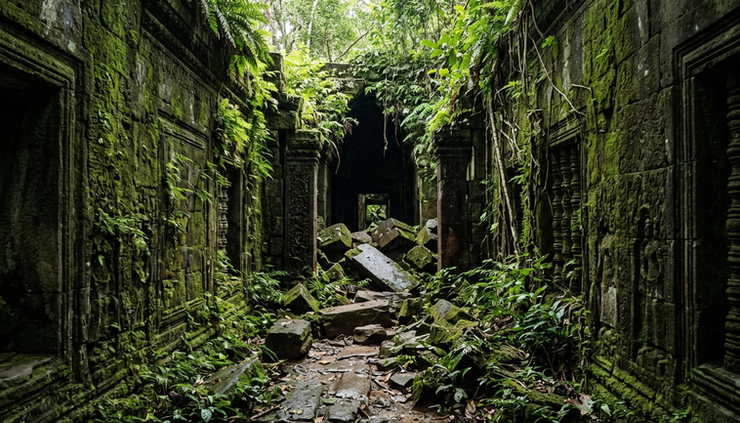
Beng Mealea is one of the best choices for travelers who want that lost-temple feeling without venturing too far into remote terrain. Located east of Siem Reap, it is a large, partly collapsed temple complex where trees, roots, stones, and galleries blend into a dramatic scene.
Unlike highly restored temples, Beng Mealea shows the power of time. Long corridors lie broken. Blocks rest where they fell. Wooden walkways help protect the site while giving visitors a clear route through the ruins.
A half day is enough if leaving from Siem Reap, but a full day works better if pairing Beng Mealea with Koh Ker. That combined route is popular for travelers who want to go beyond the standard Angkor temple circuit.
Koh Ker was once the center of the Khmer Empire
Koh Ker served as a Khmer capital in the 10th century, and it feels very different from the main Angkor sites. The standout monument is Prasat Thom, a stepped pyramid rising above the surrounding forest. Its shape gives Koh Ker a bold profile that visitors do not expect if they only know Angkor Wat’s towers.
The wider Koh Ker area includes many other structures, such as sanctuaries, reservoirs, and smaller temples. Some are close to the main route, while others take more effort to reach. The site rewards curiosity, but even a focused visit to Prasat Thom and nearby ruins feels worthwhile.
Plan a full day from Siem Reap if visiting Koh Ker alone. If combining it with Beng Mealea, start early and expect a long but rewarding day. Travelers with a deep interest in archaeology may prefer an overnight in the broader region, then continue toward Preah Vihear.
Preah Vihear delivers one of Cambodia’s greatest temple settings
Preah Vihear stands on a cliff in the Dângrêk Mountains near the Thai border. Its location is spectacular. The temple follows a long north-south axis, rising through a sequence of causeways, stairways, pavilions, and courtyards before reaching views over the Cambodian plains.
The journey is part of the experience. Preah Vihear is not as simple as a short hop from Siem Reap. It can be visited as a long day trip, but that makes for a tiring schedule. Staying overnight in Preah Vihear province allows more breathing room.
Plan a full day at minimum. If coming from Siem Reap, consider making it part of a two-day route with Koh Ker. This gives the temple the time and attention it deserves.
Preah Vihear is also a UNESCO World Heritage Site, recognized for its exceptional architecture and setting. Its remote feel gives it a different emotional weight than the busier temples near Siem Reap.
Sambor Prei Kuk reveals Cambodia before Angkor
Sambor Prei Kuk, near Kampong Thom, is one of the most important pre-Angkorian sites in Cambodia. Its brick temples date from the Chenla period, before the rise of Angkor as the region’s dominant power.
The site feels quiet and spread out, with clusters of brick towers set among trees. The architecture is older and more restrained than Angkor’s grand sandstone temples, which makes it especially interesting. Sambor Prei Kuk helps connect the dots between early Cambodian kingdoms and the later Khmer Empire.
Plan a half day if staying in Kampong Thom. If traveling between Phnom Penh and Siem Reap, Sambor Prei Kuk can also fit as a meaningful stop along the way, though it is best not to treat it as a quick roadside detour. The site deserves time.
More ancient temples worth adding if time allows
Five temples can make a strong trip, but Cambodia has many more remarkable sites. If the schedule allows, these temples add depth and variety.
Banteay Chhmar is remote and deeply rewarding
Banteay Chhmar sits in northwest Cambodia, closer to the Thai border than to the regular Siem Reap circuit. It is a large temple complex with atmospheric ruins, overgrown sections, and important carved galleries.
This is a place for travelers who like slower exploration. The experience feels less managed than the major Angkor temples, which is part of its appeal. Getting there takes effort, so plan an overnight stay rather than trying to squeeze it into a packed day.
Preah Khan of Kampong Svay suits serious temple lovers
Not to be confused with Preah Khan in Angkor, Preah Khan of Kampong Svay is a vast and remote temple complex. It was once one of the largest enclosed temple sites in the Khmer world. Because it is harder to reach, it sees far fewer visitors.
This temple is best for travelers with extra time, strong interest, and a willingness to handle rougher logistics. It may require a private vehicle and a flexible schedule, especially outside the dry season.
Phnom Chisor is an easy escape from Phnom Penh
Phnom Chisor is a hilltop Angkorian temple south of Phnom Penh. The climb is part of the visit, and the reward is a mix of ancient stonework and broad countryside views.
It does not have the scale of Koh Ker or the carved richness of Banteay Srei, but it makes a satisfying day trip for anyone based in the capital. Plan a half day to full day, depending on how many nearby stops are included.
How long to plan for Cambodia’s ancient temples
The right amount of time depends on how far beyond Angkor Wat the trip should go. A short visit can still be excellent, but trying to cover too much will turn temples into a blur.
If you have three days
Base the trip in Siem Reap. Spend one day at Angkor Wat and the main Angkor temples, then use the other days for nearby lesser-known sites.
A strong three-day plan could include:
Angkor Wat, Bayon, and Ta Prohm
Banteay Srei and countryside stops
Beng Mealea, with time to rest afterward
This gives a taste of variety without long travel days.
If you have five to seven days
This is the sweet spot for many visitors. Start in Siem Reap, then add a full-day trip to Koh Ker or a two-day route toward Preah Vihear.
A balanced plan might include:
Two days in Angkor Archaeological Park
One half day at Banteay Srei
One day at Beng Mealea and Koh Ker
One or two days for Preah Vihear
One rest or travel day
That schedule gives space for both famous monuments and quieter ruins.
If you have 10 to 14 days
With two weeks, Cambodia’s temple map opens up. Add Kampong Thom for Sambor Prei Kuk, consider Banteay Chhmar, and include time in Phnom Penh with a possible trip to Phnom Chisor.
This length works well because it respects travel time. Cambodia’s roads have improved in many areas, but distances still take energy. Heat, early starts, and bumpy rural routes add up.
If you have a month or more
A month allows a serious temple-focused journey. Even then, seeing every ancient temple in Cambodia is not realistic. Many sites are small, hard to access, poorly marked, or not prepared for casual visitors.
A longer trip should focus on regions rather than a checklist. Spend several days around Siem Reap, move north for Koh Ker and Preah Vihear, head west for Banteay Chhmar, and travel through Kampong Thom for Sambor Prei Kuk.
Should you try to visit all of Cambodia’s ancient temples?
The short answer is no.
Trying to visit all of Cambodia’s ancient temples would take far more than a normal vacation. With more than 4,000 known ancient temple sites, the challenge is not only the number. It is the condition, location, and accessibility of those sites.
Some temples are major archaeological parks. Others are fragments in villages, forested mounds, or scattered stones known mainly to researchers and local communities. Some may lack signs, maintained paths, guides, or easy transport. A few may sit in areas where access changes by season or road condition.
A better goal is to build a trip around contrast:
One iconic temple Angkor Wat gives scale and grandeur.
One finely carved temple Banteay Srei shows artistic detail.
One jungle ruin Beng Mealea adds atmosphere.
One former capital Koh Ker brings historical context.
One remote or hilltop temple Preah Vihear, Banteay Chhmar, or Phnom Chisor adds a sense of journey.
One early temple group Sambor Prei Kuk reveals the world before Angkor.
This approach gives a fuller picture of Cambodia’s ancient heritage without turning the trip into a race.

Practical tips for temple travel in Cambodia
A little planning makes temple days more rewarding. The sites are beautiful, but the climate and travel distances can be demanding.
Start early when possible. The cooler morning hours make walking easier, and the light is often better for photography. Bring more water than expected, especially for exposed sites like Preah Vihear or Koh Ker.
Dress respectfully. Many temples are active cultural and spiritual places, even when they are also archaeological sites. Lightweight clothing that covers shoulders and knees works well in the heat.
Hire local guides when the site merits it. At places such as Sambor Prei Kuk, Koh Ker, and Preah Vihear, a good guide can explain what might otherwise look like disconnected stones and towers. The stories make the ruins easier to read.
Do not underestimate rest. Temple fatigue is real. After several days of early starts, stone stairways, and long drives, even the most beautiful sanctuary can start to feel like another stop. Build in downtime, especially if traveling in the hottest months.
Most of all, stay flexible. Weather, road work, holidays, and energy levels can change the rhythm of a trip. Cambodia’s temples reward patience.
The best temple journey is selective, not exhaustive
Angkor Wat may be Cambodia’s most famous monument, but the country’s ancient temples form a much wider story. Banteay Srei shows masterful carving. Beng Mealea brings the drama of ruins and forest. Koh Ker recalls a former capital. Preah Vihear commands a mountain ridge. Sambor Prei Kuk reaches back to the centuries before Angkor.
For most travelers, five to seven days is enough for a rich first temple-focused trip. Ten to 14 days allows a deeper route. A month can still only scratch the surface.
Do not try to see every temple. Choose well, travel slowly enough to notice the details, and let each site feel distinct. Cambodia’s ancient world is too vast for a checklist, and far more rewarding than one.


Comments